[Our services]
Workers’ Compensation Investigations
Document the activity. Report it accurately.
When a workers’ compensation claim raises questions, documented facts help. TJS conducts workers’ compensation investigations that record observable activity and relevant public information, reported without exaggeration.
Start Your InvestigationContact Us
Speak to an Investigator (888) 600-0261
01. Overview
Facts relevant to reported restrictions.
Most workers’ compensation claims are legitimate. Some raise questions about whether a claimant’s activity is consistent with reported restrictions or work status. In those cases, objective documentation helps employers, adjusters, and defense counsel evaluate the claim fairly.
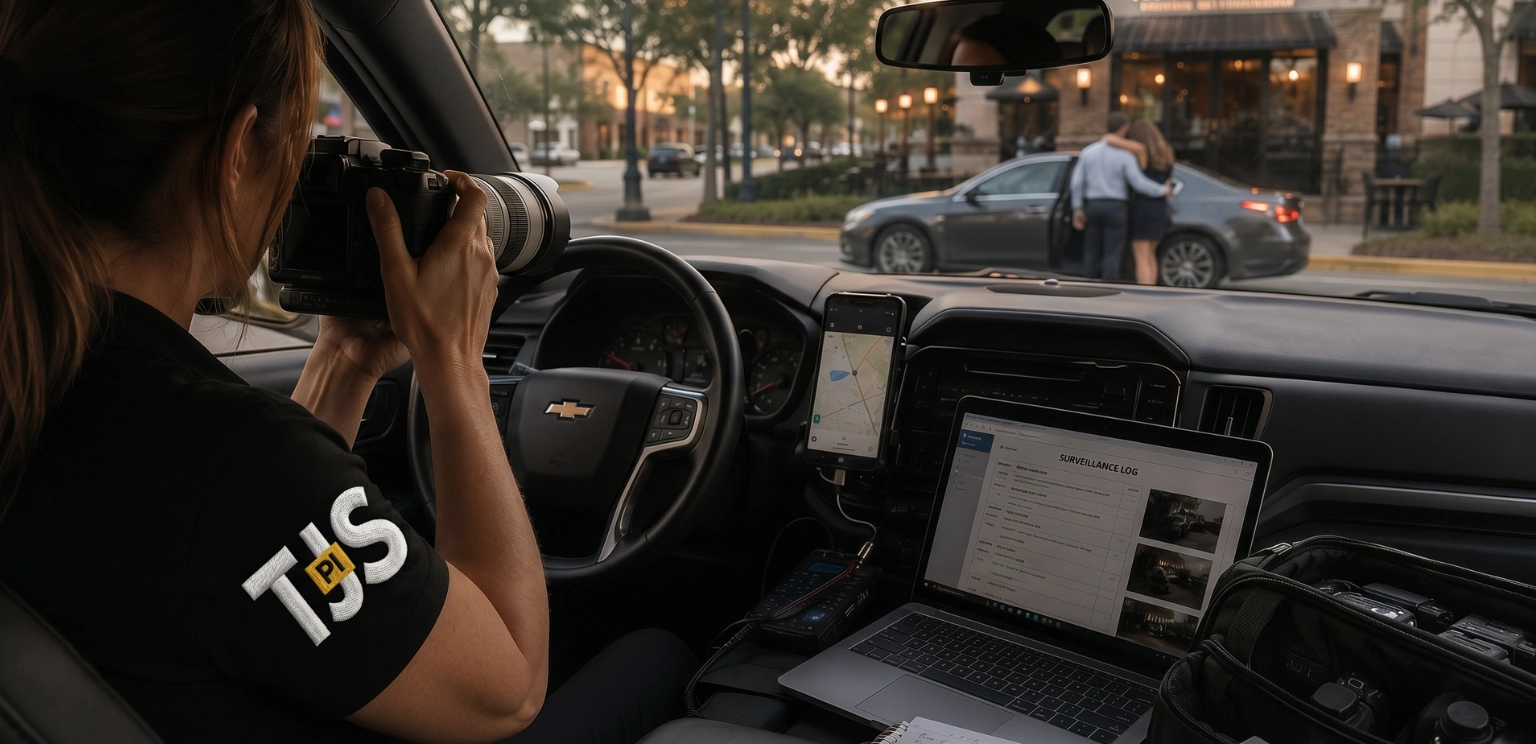
TJS Private Investigations conducts workers’ compensation investigations using lawful surveillance in public settings, background research, and review of publicly available social media content. We record what a claimant does, not what we assume, and note the context around every observation.
When a workers’ compensation investigation may help:
- Reported restrictions appear inconsistent with other information
- A tip suggests the claimant is working elsewhere
- Treatment attendance patterns raise questions
- Public posts appear to show strenuous activity
- The claimant’s address or work status needs confirming
- A claim has reached a point where an updated picture would help
- Defense counsel needs facts before a hearing or settlement discussion
We work within legal limits. We do not enter private property, misrepresent who we are, or access private accounts. Many files begin with a short activity check before longer coverage is considered.
02. Capabilities
Lawful methods. Careful documentation.
Surveillance in Public Settings
Observe and record activity in places where the claimant can be seen from public areas. Read more about our surveillance work.
Restriction-Focused Observation
Note specific activities, such as lifting, bending, carrying, or driving, that relate to the restrictions in the file.
Public Social Media Research
Review publicly available posts and profiles for content relevant to activity or employment, preserving what is found with dates where shown.
Background Research
Research available records for address history, business affiliations, and other information relevant to the claim.
Employment Indicators
Document observable signs of work, such as regular attendance at a job site, where relevant to the claim.
Time-Stamped Video
Provide video with date and time information so reviewers can compare observed activity with the claim timeline.
03. Our Investigators
Patience, accuracy, and restraint.
Workers’ compensation surveillance often involves long stretches with little to see. A useful result depends on preparation, well-chosen observation windows, and an investigator who records only what is visible and avoids medical conclusions.
With more than 17 years of investigative experience, TJS knows a single clip rarely tells the whole story. We describe duration, frequency, and context, so a brief task isn’t presented as proof of full capacity. Our team is based in Houston, Texas and works on claims across the states we serve.
04. What Clients Receive
A factual record of what was observed.
Depending on the assignment and the activity observed, your deliverables may include:
- A narrative report for each day of coverage
- Time-stamped video of relevant observed activity
- Descriptions of activities related to reported restrictions
- Captures of relevant publicly available social media content
- Background research findings
- Notes on periods with no observable activity
- A summary comparing observations with the questions in the referral
Investigators do not assess medical capacity. Whether observed activity conflicts with a restriction is a judgment for the adjuster, treating physician, or counsel. Periods without observed activity are reported, not left out.
05. Why Choose TJS
Fair to the claimant. Useful to your file.
Experienced
More than 17 years of investigative experience inform how we plan and conduct coverage.
Lawful
We stay within legal boundaries and avoid methods that could undermine the evidence.
Balanced
Reports include context and quiet periods, not only selected moments.
Clear Communication
You receive updates during coverage so decisions about further days can be made in time.
06. How It Works
Planned around the claim file.
- 01.
Review the Claim
Share the restrictions, injury details, addresses, and the concerns that prompted the referral.
- 02.
Plan Coverage
We discuss days, hours, research tasks, budget, and the reporting format you need.
- 03.
Document Activity
Investigators carry out the research and surveillance, recording relevant activity on time-stamped video.
- 04.
Report Findings
You receive a factual report and video to review with your medical and legal advisors.
07. Frequently Asked Questions
Common questions about workers’ comp surveillance.
1. Is workers’ compensation surveillance legal?
Surveillance conducted from public settings, without trespass or deception, is generally permitted. Rules can vary, so we plan each assignment with the applicable requirements in mind.
2. Do you look at a claimant’s social media?
We review publicly available content only. We do not create false profiles, send requests under a pretext, or access private accounts.
3. What if the claimant isn’t seen during surveillance?
We report the hours covered and what was observed. Limited activity is a finding in itself, and we can discuss whether further coverage is worthwhile.
4. Can surveillance prove a claim is fraudulent?
Surveillance documents activity. Whether that activity conflicts with the claim, or amounts to fraud, is decided by the carrier, medical providers, and the appropriate authorities.
5. How many days of surveillance are usually needed?
It depends on the claimant’s routine and the questions in the file. We recommend a plan based on the referral and adjust it as information develops.
08. Next Steps
Start with the claim file.
Send the claim details and the restrictions in question. We’ll recommend an approach that fits the file and confirm the scope before starting. You can also see how we support insurance professionals more broadly.

[Ready to start a conversation]
Document the activity. Decide with confidence.
Tell us what the claim file needs. We’ll explain how a workers’ compensation investigation can provide the facts for your review.
Speak to an Investigator (888) 600-0261
Copyright © 2026 TJS Private Investigations. All rights reserved.